- Description
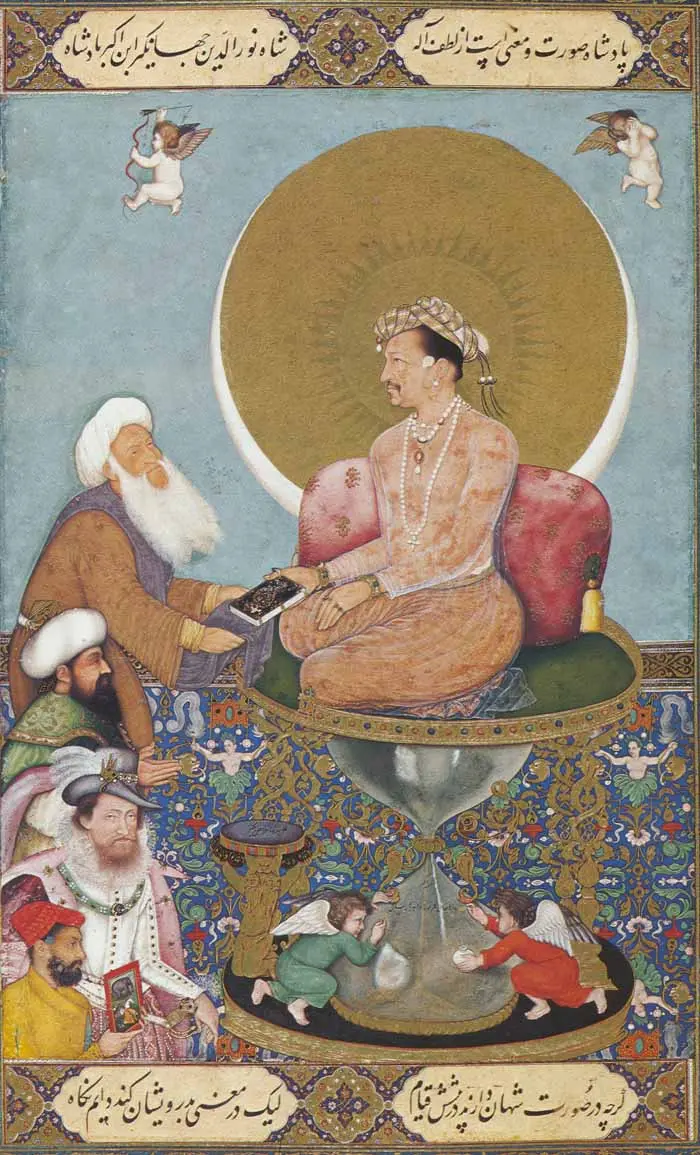
- Before passing away, Emperor Jahangir chooses the Sufis over all others (Bichitr, c. 1660)
Jahangir (d.1627) preferring Sufi shaikhs over King James I of England; by Bichitr, earlier 1620s Source: Stuart Cary Welch, Imperial Mughal Painting. New York: George Braziller, 1978. Image: Plate 22, p. 82; scan by FWP, Aug. 2001 Commentary by Stuart Cary Welch: "Haggard and resignedly gazing upwards, Jahangir offers a book to Shaikh Husain of the Chishti Shrine, a spiritual descendant of Shaikh Salim, to whom Akbar had gone prayerfully (and successfully) in the hope of an heir. The boon was granted, and at birth the prince, later Jahangir, was named Salim in gratitude to the saint. In this allegory, painted almost a lifetime later, Jahangir sits on an hourglass throne. Although cupids have inscribed it with the wish that he might live a thousand years, the sands of time have almost run out. The Emperor is turning from this world to the next. The picture is inscribed, "Though outwardly shahs stand before him, he fixes his gazes on dervishes." He offers the book (of his life?) to the saint rather than to the earthbound standing by his curious throne; not to the Ottoman sultan (a generalized likeness based perhaps on a European print): nor to King James I of England (copied from an English miniature); and not even to Bichitr, a symbolic ruler of art, who painted himself holding a miniature showing two horses and an elephant--presents from his appreciative patron--and a deeply bowing self-portrait. Like the hourglass throne, which may have been based on a small gilt-bronze and glass original, the idea of allegorical state portraits came from Europe, as did the cupids, who cover their eyes, either out of sadness for the aging emperor, or, more likely, for protection against the blinding radiance of his sun and moon halo. Bichitr was a brilliant young follower of Abu'l Hasan who became one of Shah Jahan's leading court artists. Like Abu'l Hasan, he was prolific and all-encompassing, capable of painting everything from complex historical subjects to animals, highly inventive ornament, and sensitive individual portraits. The verse quoted above was translated by Wheeler Thackston."

Your comment
Comment without signing up
Your comment will be shown after management approval. Profanity and insults are not allowed; comments without them will be approved. The name you choose may be a pseudonym or a fictional name.